

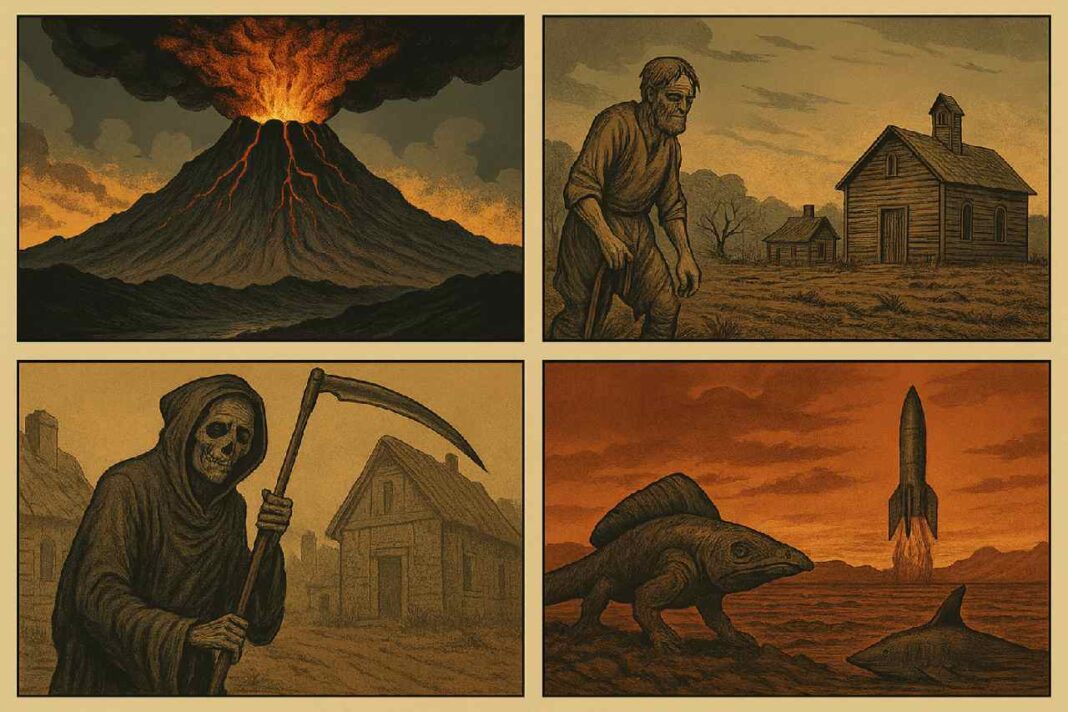

Humanity’s survival has often seemed like an improbable feat, given the numerous threats it has faced throughout history. From natural disasters to human-made catastrophes, civilization has been pushed to the brink of annihilation on multiple occasions. These events serve as stark reminders of both the fragility of life and the resilience of human beings in the face of overwhelming challenges. Here, we explore five historical events that nearly ended it all for humanity.
1. The Toba Super Eruption: A Cataclysmic Volcano That Could Have Ended Humanity
Approximately 74,000 years ago, one of the most catastrophic volcanic eruptions in Earth’s history occurred at the Toba supervolcano, located on the island of Sumatra in Indonesia. The eruption released an astonishing 2,800 cubic kilometers of volcanic material into the atmosphere, which created a caldera that eventually became Lake Toba. The eruption’s effects on the global climate were profound, as it spewed massive amounts of sulfur dioxide and ash into the atmosphere, potentially triggering a volcanic winter.
The cooling effect of this eruption is believed to have lowered global temperatures by 3 to 5 degrees Celsius. Such a drastic climate change could have resulted in widespread crop failures and severe food shortages, threatening the survival of human populations around the world. Some scientists even hypothesize that the eruption caused a significant bottleneck in human genetic diversity, as the global human population may have been reduced to a dangerously small size.
However, archaeological evidence from southern India suggests that humans continued to thrive in certain regions despite the eruption’s effects, challenging the theory that the Toba eruption caused widespread extinction. While the full extent of the eruption’s impact on humanity remains debated, the Toba event is a reminder of the power of natural disasters to alter the course of history.
2. The Year Without a Summer: A Volcanic Eruption That Altered the Global Climate
In 1815, Mount Tambora, located on the island of Sumbawa in Indonesia, erupted with catastrophic force. This eruption released 37 cubic kilometers of material into the atmosphere, making it one of the most powerful volcanic events in recorded history. The resulting ash and sulfur dioxide formed a thick layer in the stratosphere, which reflected sunlight and caused global temperatures to drop. As a result, the year 1816 became known as “The Year Without a Summer.”
The sudden cooling caused widespread crop failures across Europe and North America, leading to food shortages, famine, and civil unrest. The European continent, in particular, experienced crop losses due to unseasonably cold temperatures and heavy rainfall. In addition to the economic and social upheaval, the climate anomaly also contributed to the spread of disease, including cholera, which devastated populations in India and China.
The Year Without a Summer highlighted the vulnerability of human societies to abrupt climatic changes. It also sparked cultural shifts, with the gloomy, cold weather inspiring the writing of Mary Shelley’s Frankenstein, considered one of the earliest works of science fiction. This event serves as a powerful reminder that the Earth’s climate can undergo drastic shifts with little warning, threatening the stability of human civilization.
3. The Black Death: A Pandemic That Changed the Course of History
One of the deadliest pandemics in human history, the Black Death, struck Europe in the mid-14th century. Caused by the bacterium Yersinia pestis, the disease spread rapidly through Europe, killing an estimated 30% to 60% of the population. The plague was transmitted by fleas that infested rats, which were common aboard ships and throughout trade routes.
The Black Death decimated entire towns and cities, leading to widespread social, economic, and political collapse. The pandemic’s swift spread overwhelmed medical knowledge of the time, and public health responses were often ineffective. The psychological toll was also profound, with many people viewing the plague as a divine punishment, leading to widespread religious and social upheaval.
In addition to its immediate impact, the Black Death triggered long-term societal changes. Labor shortages due to high mortality rates led to better working conditions for peasants, undermining the feudal system and contributing to the rise of a more modern economic structure. While the pandemic caused immense suffering, it also set the stage for significant changes in European society.
The Black Death’s widespread death and destruction left a lasting mark on European culture, with artistic depictions of death becoming prevalent in the years that followed. The Danse Macabre, or Dance of Death, became a common motif in art, emphasizing the inevitability of death and the universality of human mortality.
4. The Permian-Triassic Extinction: Earth’s Greatest Catastrophe
Around 252 million years ago, Earth experienced its most devastating mass extinction event: the Permian-Triassic extinction, also known as the “Great Dying.” This event wiped out approximately 81% of marine species and 70% of terrestrial vertebrates, making it the most catastrophic extinction in Earth’s history.
The cause of this massive die-off was likely a combination of volcanic activity and subsequent environmental changes. The Siberian Traps, a vast volcanic region in present-day Russia, erupted over the course of two million years, releasing vast quantities of carbon dioxide into the atmosphere. This caused a dramatic rise in global temperatures, ocean acidification, and a loss of oxygen in the oceans, which decimated marine life.
The Great Dying disrupted ecosystems on a global scale, and the recovery of biodiversity took millions of years. This event underscored the delicate balance of life on Earth and the potential consequences of environmental disruptions. Despite the scale of the disaster, life eventually rebounded, but the extinction of so many species left a permanent imprint on the planet’s evolutionary trajectory.
5. The Cuban Missile Crisis: A Nuclear Showdown That Nearly Triggered Global War
The Cuban Missile Crisis, which took place in October 1962, brought the world to the brink of nuclear war. This 13-day confrontation between the United States and the Soviet Union began when the Soviet Union secretly deployed nuclear missiles in Cuba, just 90 miles off the coast of Florida. In response, the United States placed Cuba under a naval blockade, and tensions escalated as both superpowers stood on the verge of war.
The crisis was triggered by the placement of Soviet missiles in Cuba, which shifted the global balance of nuclear power. U.S. reconnaissance planes had discovered the missile sites, and President John F. Kennedy, with his advisors, made the critical decision to confront the Soviet Union through a naval blockade rather than immediate military action. Diplomatic efforts were underway to resolve the crisis, but the situation remained tense, with the risk of nuclear war hanging over the world.
At the height of the crisis, an American U-2 spy plane was shot down over Cuba, further escalating tensions. Despite calls for military retaliation, President Kennedy chose diplomacy, and after intense negotiations, the Soviet Union agreed to remove its missiles from Cuba in exchange for a secret promise from the U.S. to withdraw its missiles from Turkey. The Cuban Missile Crisis demonstrated the fragility of global peace during the Cold War and the critical importance of diplomacy in avoiding global catastrophe.
The Thin Line Between Survival and Extinction
Throughout history, humanity has faced multiple existential threats, ranging from natural disasters to human-made crises. Each of these events tested the resilience of our species and highlighted the vulnerability of life on Earth. While the world has survived these close calls, the lessons learned from these events should not be forgotten. They serve as a reminder of the delicate balance required to maintain the stability of our planet and the survival of humanity.
From volcanic eruptions and pandemics to nuclear standoffs, these events show the unpredictable forces that have shaped our world. The survival of humanity is not guaranteed, but history has demonstrated our ability to endure and adapt in the face of catastrophe. However, the question remains: How many more close calls can we survive before our luck runs out? The future of civilization may depend on our ability to learn from the past and take action to prevent future global disasters.