

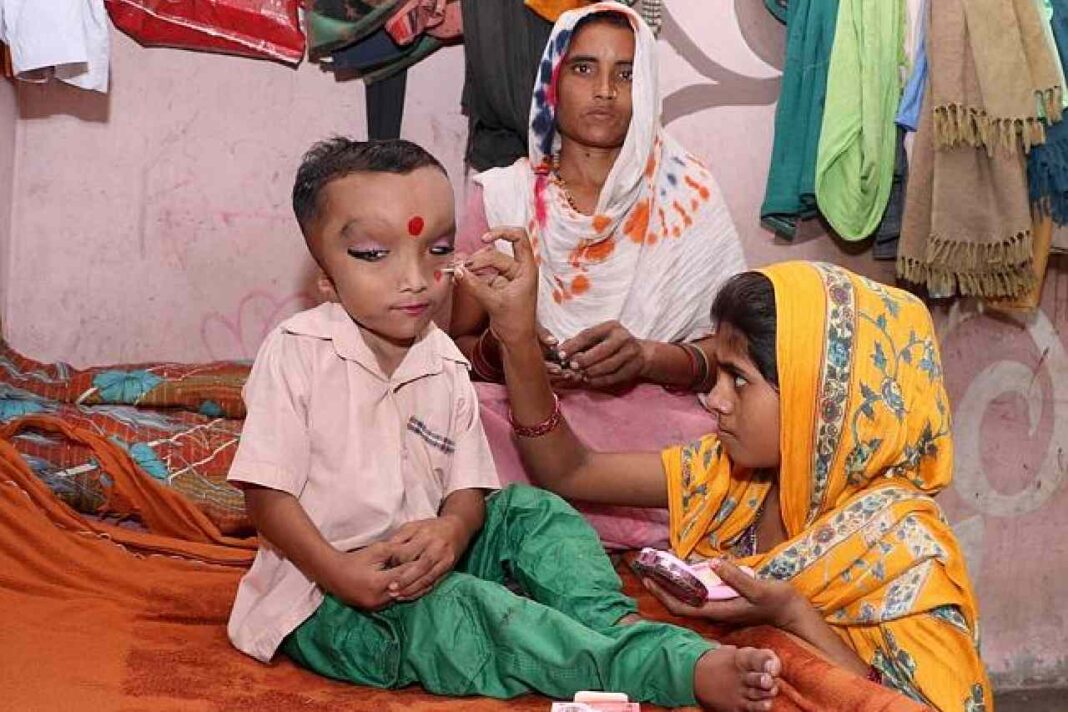

In the city of Jalandhar, Punjab, an 8-year-old child named Pranshu has become a subject of fascination for many, with some people regarding him as a living embodiment of Lord Ganesha, the Hindu god of beginnings and the remover of obstacles. Pranshu’s physical appearance, particularly the size and shape of his head and eyes, bears an uncanny resemblance to the traditional depictions of Lord Ganesha, who is often shown with the head of an elephant and a human body. This resemblance has led to widespread attention, with many people visiting him in hopes of receiving his blessings.
Pranshu, born with a rare condition that has caused physical deformities, remains upbeat and accepts the attention with humility. “My head and eyes are large in size. I look like Ganesh Ji (Hindu God), and people come up to me and I bless them,” Pranshu said when asked about his condition. Despite the unusual circumstances, the child appears to have adapted to his role in the community, greeting visitors and offering blessings with a calm demeanor.
Many individuals who meet Pranshu are struck by his appearance and the sense of awe that comes with it. Some view him as a manifestation of Lord Ganesha, believing that he embodies the deity’s attributes, including the power to remove obstacles and bring good fortune. As a result, people have come to see Pranshu as a source of spiritual significance, seeking his blessings in the hope of improving their lives. It is not uncommon for visitors to bow down before him or touch him as a gesture of reverence.
The connection between Pranshu and Lord Ganesha is deeply rooted in Hindu tradition. Lord Ganesha is considered a deity associated with wisdom, learning, and success, and is often invoked during times of new beginnings or when one is facing challenges. In light of this, Pranshu’s role as a figure of spiritual significance has drawn attention from individuals who believe in the positive effects of his presence.
While some may be skeptical of the notion that Pranshu is a divine figure, the local community’s response to him cannot be ignored. People from all walks of life, including those from different religious backgrounds, have approached Pranshu to receive his blessings. His father, in particular, has expressed deep respect for his son’s perceived connection to Ganesha, often referring to him as “Ganesha” in recognition of the comparisons made by others. Pranshu’s father has also shared that when Pranshu moves around the area, he is greeted by locals who acknowledge him with phrases like “Hail, Lord Ganesha.”
It is important to note that Pranshu’s case raises questions about the intersection of belief, faith, and medical understanding. While Pranshu’s condition has been described as a deformity by doctors, the impact of his appearance on the people around him cannot be dismissed. His presence has sparked conversations on the nature of belief, the human tendency to ascribe spiritual meaning to certain events or individuals, and the cultural significance of symbols like Ganesha in Indian society.
Pranshu’s story is an example of how religious and spiritual beliefs often shape the way people perceive and interact with the world. In some parts of India, where faith plays a central role in daily life, individuals like Pranshu can become symbolic figures, representing the hope for new beginnings and the removal of obstacles. This phenomenon is not unique to Pranshu; similar stories of individuals being seen as divine manifestations or embodiments of gods have occurred in various parts of the world throughout history.
From a medical standpoint, Pranshu’s condition remains unexplained. Doctors have been unable to identify the exact cause of his physical appearance, and while his deformities are clearly noticeable, they do not appear to cause him significant harm. The child leads a relatively normal life, interacting with people in his community and carrying on with his daily activities. However, the medical community continues to express curiosity about the origins of his condition.
In conclusion, the story of Pranshu, the boy from Jalandhar, underscores the complex relationship between religion, belief, and human experience. While some view him as a divine figure, others may attribute his condition to a medical anomaly. Regardless of the interpretation, Pranshu’s presence has undoubtedly made an impact on those who have encountered him. His case serves as a reminder of the powerful role that faith and belief systems play in shaping perceptions and experiences, especially in a society where spirituality is deeply embedded in the cultural fabric.