

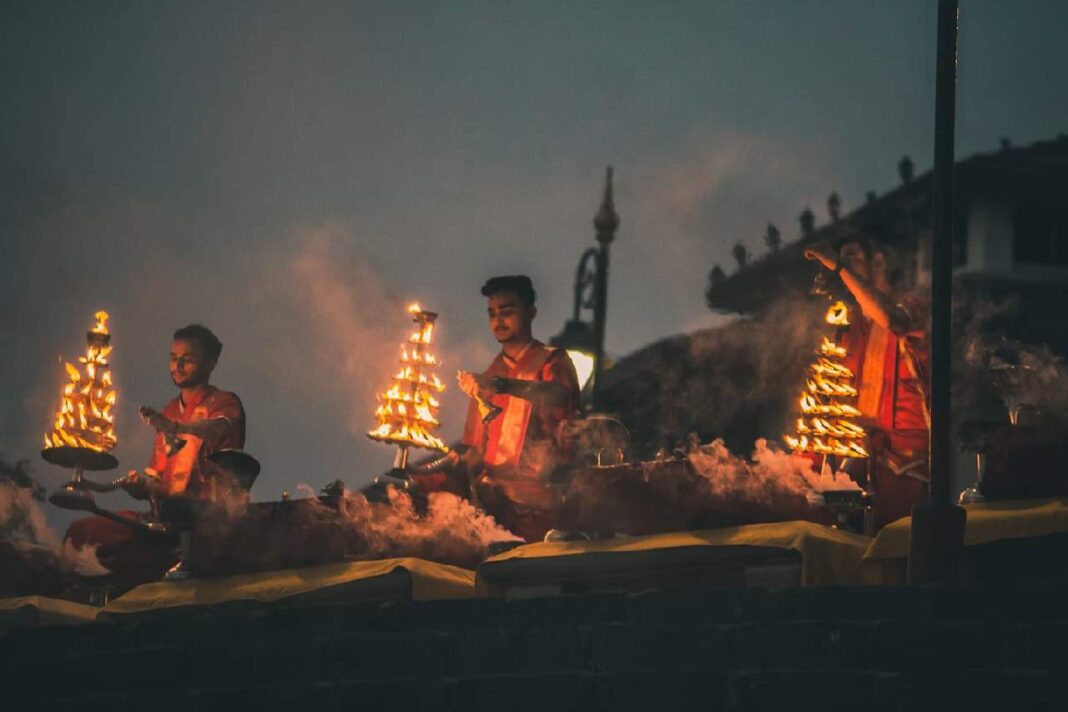

Banaras, or Varanasi, is often referred to as the city of life and death, where time stands still and history lingers in every corner. It is a city with a spiritual essence that transcends the mundane, where the echoes of ancient rituals and untold stories are woven into the fabric of everyday life. Positioned along the banks of the sacred Ganga, Banaras holds both a sense of reverence and mystery, where every step leads to an unseen chapter of history, every ghat hides a secret, and every corner whispers an untold tale.
Known for its ghats, temples, and its spiritual significance, Banaras is the epicenter of Hindu culture, drawing millions of pilgrims and tourists from across the world every year. The ghats, especially Manikarnika Ghat, the oldest and most famous cremation ghat, symbolize the city’s unique position at the crossroads of life and death. Yet, beyond the visible rituals and practices, there exists an intangible side to Banaras, one that speaks of unvoiced stories and mysteries that continue to linger even after death.
The Sacred Ghats and the Forgotten Stories
One of the most profound aspects of Banaras is its role in the process of death. For Hindus, the ultimate goal is to attain moksha — liberation from the cycle of birth and rebirth. Manikarnika Ghat is a prominent site where many come to cremate their loved ones, believing that the sacred river Ganga will cleanse their souls and guide them towards salvation. Yet, the city’s deep connection with death extends beyond rituals; it also holds the stories of those who have passed away, but whose lives remain forgotten.
Every year, thousands of bodies are cremated at the ghats, yet each individual has a story — a narrative that often remains untold. It is not just the physical act of cremation that matters, but the lives lived, the voices silenced, and the dreams unfulfilled. Banaras, while a place of spiritual culmination, is also a city that harbors many such unfinished stories, waiting to be heard.
Durgesh Pandit, a long-time priest at Manikarnika Ghat, has spent years witnessing the rituals of life and death. Yet, even for him, the city never fails to surprise. “Banaras is a place where the boundaries between life and death blur,” he explains. “People come here for spiritual solace, but the city holds more — it holds the voices of those whose stories are lost, those whose lives remain unfinished.”
One evening, as Durgesh sat by the river after performing the last rites for a young woman who had passed away unexpectedly, an unusual encounter unfolded. A voice, soft and hesitant, called out to him — it was the voice of the girl he had just cremated. However, she was not wrapped in white, the traditional attire for the dead, but in a red Banarasi saree, still adorned with her wedding bangles.
“I don’t want to disappear just yet,” she told Durgesh, revealing a desire to be heard, even after death.
In that brief moment, Durgesh was forced to confront something that had long lingered in his thoughts. Banaras is more than a place of physical rites; it is a city where forgotten souls call out from the shadows, asking for their stories to be told.
A Story Left Behind
The girl’s story is not unique. Banaras is filled with the forgotten and the forsaken — those whose lives were cut short or whose tales remain buried in the annals of history. But it is in these forgotten narratives that the true spirit of Banaras resides. The city is not just a place of endings but also of beginnings, where the journey of the soul is intertwined with the stories that live on in memory.
As Durgesh listened to the girl’s words, he understood the profound truth embedded in them. “When I was alive, no one listened. Now that I’m gone, only my ashes remain. Will anyone ever tell my story?” she had asked. For Durgesh, this moment crystallized the deep connection between death and the legacy left behind. Even after death, the desire for recognition, for one’s story to be told, remains.
Moved by her words, Durgesh did not let the story go untold. That night, by the river, he wrote the girl’s story, preserving it in the written word, ensuring that her voice would not be lost. It was a story of a young woman who lived with dreams unfulfilled, a story that echoed not just through the temples and ghats, but through the very heart of Banaras.
The girl’s tale began to circulate through the city, whispered on the winds, passed from one person to another, carried by the Ganga’s flowing waters. Over time, it became a part of the city’s mythos, a reminder that Banaras, while a city of death, is also a city of stories — some known, some hidden, and some waiting to be discovered.
The Mystical Essence of Banaras
Manikarnika Ghat, like the rest of Banaras, is a place where life’s greatest truths unfold — everything ends, but nothing is ever truly lost. The city, with its ancient rituals, its bustling streets, and its timeless ghats, holds an ethereal quality that blends spirituality with mystery. It is a place where death does not signify an end but rather the beginning of a new journey, both for the soul and for the stories that remain.
In Banaras, there is a belief that when one’s pride blinds them, they should visit Manikarnika Ghat. It is here that the ultimate truth of life and death becomes clear — everything ends, but everything also continues, in stories, in memories, and in the undying spirit of the city.
Banaras, the eternal city, stands as a reminder that death is not an end but a passage, and even the most fleeting moments, the most forgotten lives, leave behind echoes that reverberate through time.
Conclusion: The City of Unspoken Stories
Banaras continues to be a city of contradictions — sacred and profane, ancient and modern, vibrant and desolate. But it is also a city of untold stories, stories that defy time and transcend death. Through every ghat, every temple, and every whisper of the Ganga, the city continues to speak of lives lived, stories left behind, and the eternal cycle of life and death.
Banaras, in its quiet majesty, reminds us that while death may take away the physical form, it can never silence the stories that define us. In this city, no one is truly forgotten — their stories live on in the air, in the river, and in the hearts of those who dare to listen.