

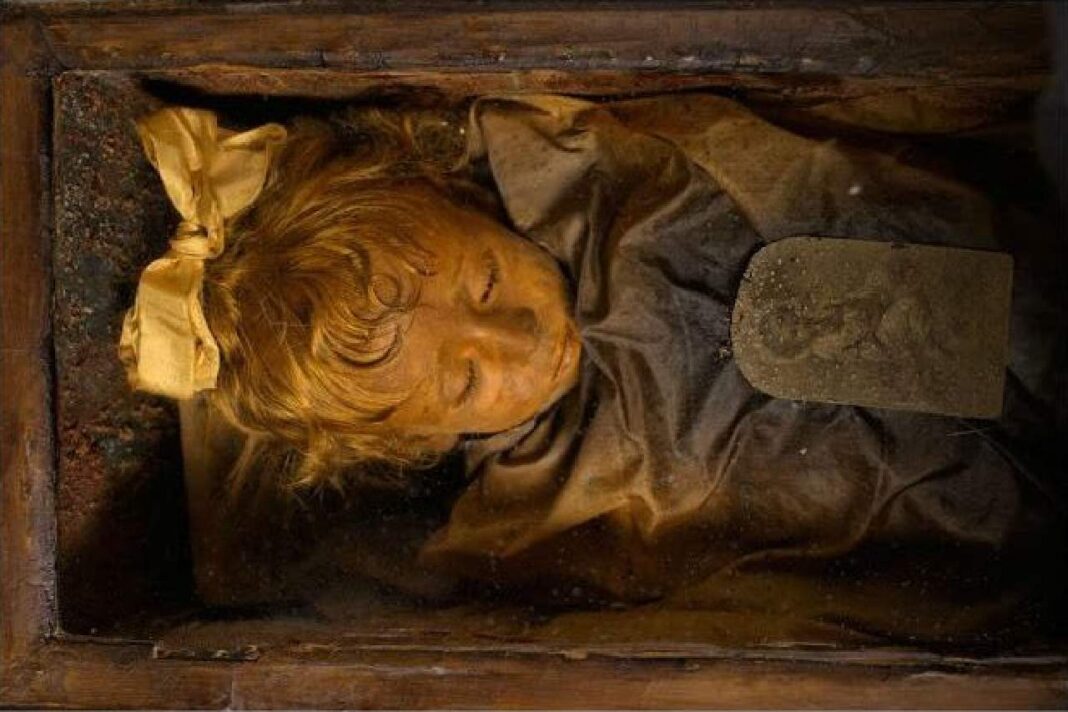

For over a century, a curious phenomenon has captivated the attention of visitors and researchers alike. Deep within the Capuchin Catacombs in Palermo, Italy, lies the mummified body of a two-year-old girl named Rosalia Lombardo. Although she passed away in 1920, her remains have remained in a remarkably lifelike state, leading to an unsettling claim: Rosalia appears to blink twice every day.
The mystery surrounding her “blinking” eyes has fascinated both the scientific community and those with a more supernatural perspective. But what is the truth behind this unusual occurrence? Is it a natural result of expert embalming techniques, or does something more mysterious explain this century-old phenomenon?
The Enigmatic Story of Rosalia Lombardo
Rosalia Lombardo’s story is tragic yet strangely captivating. Born in 1918, Rosalia fell victim to pneumonia at the tender age of two. Her parents, devastated by the loss, sought a way to preserve their daughter’s body. Enter Alfredo Salafia, a renowned embalmer and taxidermist in Palermo.
In December of 1920, Salafia undertook the delicate task of preserving Rosalia’s body. Through innovative embalming techniques, he used a special mixture of chemicals that would later come to be known for its ability to preserve bodies with exceptional precision. The mixture, which included formalin to eliminate bacteria, alcohol to dry the body, glycerin to protect the skin, salicylic acid to prevent fungal growth, and zinc salts to maintain stiffness, was unlike any other embalming solution used at the time.
Thanks to this groundbreaking method, Rosalia’s body has remained almost perfectly preserved for more than a century, earning her the affectionate nickname “Sleeping Beauty.” Despite her mummified state, she retains a lifelike appearance, with soft skin, a serene expression, and most strikingly, her eyes. It is her eyes that have been at the center of the strange phenomenon that continues to puzzle scientists and mystics alike.
The “Blinking” Phenomenon: Optical Illusion or Something More?
The key feature that has drawn thousands of visitors to the Capuchin Catacombs is the purported blinking of Rosalia’s eyes. Over the years, many observers have claimed that her eyelids appear to open and close, as if she is briefly waking from a long slumber. Photographs taken throughout the years show varying degrees of eye openness—sometimes her eyelids are nearly shut, while other times, her blue irises can be faintly seen through a slight opening. This has led to the widespread belief that Rosalia blinks twice a day, a claim that has persisted for decades.
While some see this as an optical illusion, others suggest a more supernatural explanation. The Capuchin Catacombs, home to hundreds of other mummified bodies, are considered by some to be a place of great spiritual significance, where residual energies may cause such phenomena. These unverified theories have only added to the mystery and allure surrounding Rosalia.
Yet, there is a simpler explanation that relies on science rather than the supernatural. Dr. Dario Piombino-Mascali, a prominent researcher and curator of the Capuchin Catacombs, has extensively studied Rosalia’s body and the phenomenon of her “blinking.” His research points to optical effects as the most plausible cause.
The Science Behind the Blink
According to Dr. Piombino-Mascali, the perceived blinking is a result of the way light interacts with Rosalia’s eyelids, which have never fully closed. The catacombs experience varying sunlight conditions, which change throughout the day as natural light filters into the burial chamber. These fluctuating light levels cause reflections that may appear to be eye movements.
The eyelids of Rosalia are slightly open, and as light passes through her eyes, the angle of the light can create the illusion of blinking. The shadows and light reflections on her preserved skin cause her eyelids to appear as though they are opening and closing, when in reality, they are simply remaining in the same position. Temperature and humidity fluctuations inside the catacombs also play a role, as they can cause slight shifts in the position of her eyelids or skin, contributing to the visual effect.
This explanation, while grounded in scientific observation, does little to quell the fascination with Rosalia’s preserved body. The idea that something as simple as changing light conditions could create such an eerie effect only adds to the allure and mystery of her case.
Preservation Efforts and Ongoing Concerns
Rosalia’s preservation has not been without its challenges. While her body has remained largely intact for over a century, experts have noted slight signs of deterioration in recent years. In 2009, conservators observed minor changes in the texture of her skin and slight discoloration, which indicated that the preservation process was starting to face challenges from the natural environment of the catacombs.
In response, conservationists moved Rosalia to a more controlled part of the catacombs, away from areas with higher humidity. To further protect her body, her remains were placed in a sealed glass container, filled with nitrogen gas to prevent oxidation and microbial growth. These measures have helped preserve her state for the foreseeable future, allowing future generations to continue studying her exceptional preservation.
Microbial Decomposition: A Potential Factor?
While the preservation techniques used by Alfredo Salafia are widely credited with Rosalia’s remarkable state of preservation, some scientists have speculated that microbial activity may play a role in the movement of her eyelids. After all, decomposition is a process influenced by microorganisms that break down organic materials. However, the embalming methods employed by Salafia effectively blocked these natural decomposition processes, making microbial activity an unlikely explanation for the perceived movement of her eyelids.
Instead, environmental factors, such as the fluctuating temperature, humidity, and light conditions, are more likely to be responsible for the visual effect. Despite some interest in the potential role of microorganisms, there is no scientific evidence to support the idea that they are responsible for the illusion of blinking.
The Ongoing Fascination
Rosalia Lombardo’s body continues to attract attention from researchers, tourists, and paranormal enthusiasts alike. Her perfectly preserved state, combined with the eerie mystery of her blinking eyes, has cemented her place as one of the most famous mummies in the world. Whether one views the phenomenon as a scientific curiosity or a supernatural event, there is no denying the enduring fascination that Rosalia’s story evokes.
For some, she represents a tragic loss, frozen in time for eternity. For others, she is a symbol of the human desire to conquer death and preserve life. And for many, the inexplicable blinking of her eyes serves as a reminder that, even in death, there are still mysteries that science has yet to fully explain.
Looking to the Future: Can Artificial Intelligence Solve the Mystery?
As scientific technology advances, new tools are being used to study Rosalia’s body in ways that were once unimaginable. Artificial intelligence (AI) is already being employed in forensic studies to analyze preserved remains, and it could soon help resolve the mystery of Rosalia’s blinking eyes. AI imaging techniques, such as high-resolution CT scans, are being used to examine her internal structure in unprecedented detail.
AI could potentially assist in creating digital reconstructions of Rosalia’s face, allowing scientists to study her eyelids for subtle changes that could confirm whether the blinking is a result of actual movement or simply a visual illusion. As the field of artificial intelligence continues to develop, it may offer new insights into the preservation process and the visual phenomena surrounding Rosalia Lombardo.
Conclusion: A Mystery That Endures
The case of Rosalia Lombardo and her alleged blinking eyes continues to intrigue and mystify people around the world. While scientific explanations point to optical illusions caused by light and environmental factors, the supernatural theories surrounding her preserved body persist. As long as the catacombs remain a place of historical and cultural significance, Rosalia’s story will undoubtedly continue to fascinate those who seek answers to the mysteries of life, death, and what lies beyond.
Whether viewed through a scientific lens or as part of the larger tapestry of local legend, Rosalia Lombardo’s mummified remains remain a poignant symbol of the human desire to hold on to the past—and the mysteries that still elude us.